But first… the disclaimer: One of the products we sell as a business is Voyager Infinity. A recruitment CRM for all types of contingent recruitment with a focus on temps. The main recruiter usage is done in a Window app. With a cloud backend. It’s fully cloud-enabled with web portals for other user personas (eg candidates), APIs and even an iOS/Android app for recruiters on the move. Regardless, this frustration is almost a daily occurrence for us and it’s just plain wrong.
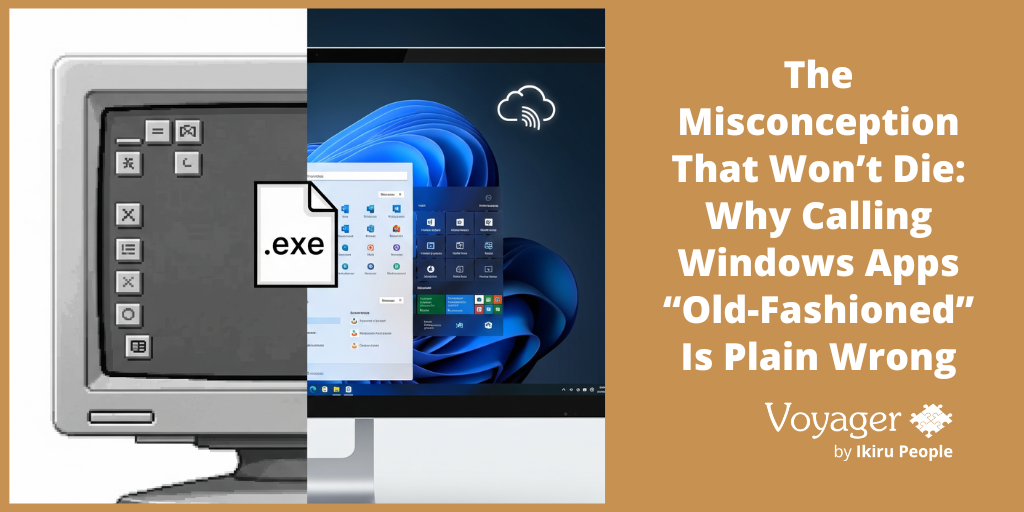
Every time I talk to someone about a Windows application, there’s always that moment.
A pause.
A raised eyebrow.
And then the inevitable phrase:
“Oh… a Windows app? Isn’t that a bit old-fashioned?”
Seriously?
We are living in a world where people spend eight hours a day inside Outlook, Word, Excel, Teams, Visual Studio, Photoshop, Slack, Steam, Discord, Notepad++…
Did you know that even LinkedIn has launched a new, Windows App?
These are the tools people rely on every single day — and guess what?
They’re Windows applications.
And nobody calls those old-fashioned.
Let’s Get This Straight: Most Work Still Happens in Windows Apps
There’s a bizarre collective amnesia happening in the tech world.
We’ve created this myth that “modern” equals “browser-only,” as if people are running their entire workday on Chrome tabs floating in the cloud like some SaaS-powered utopia.
But look at any enterprise desk in the world:
- Outlook: Desktop app
- Word: Desktop app
- Excel: Desktop app
- Teams: Desktop app
- Browser: Used mainly to load… more apps

The reality is simple:
The desktop isn’t dead. The desktop is where productivity actually happens.
People still want speed, responsiveness, keyboard shortcuts, power, and — most importantly — an interface that doesn’t feel like it’s being bottlenecked through a sandboxed web runtime.
Let me rephrase. The desktop is where some productivity actually happens.
Our Infinity CRM is a market leader in the temp staff sector. Temps need to upload documents. Temps need to fill timesheets. Clients need to sign off. Consultants need mobile access. Of course. OF COURSE, Windows software is of no use for any of this.
That’s why, we deliver our timesheet software though a browser. Our onboarding functionality is mobile first. Our phone apps are exactly that – Apps. Best of breed technology based on the user need.
The irony is that I hear some suppliers with modern browser apps but don’t offer onboarding or timesheet support within those apps – essentially promoting the pen and paper approach!
Here’s the Real Irony:
When someone dismisses a Windows application as “outdated,” what they’re really saying is: “I forgot that the tools I depend on every day are… Windows applications.”
It’s almost comedic.
The Missing Piece: Modern Windows Apps Are Not What They Used to Be
People hear “Windows application” and imagine:
- an installer from 2009
- grey buttons
- a giant .exe that stores everything on the local machine

But today’s desktop apps?
They’re cloud-connected, auto-updating, data-streaming, API-driven, secure, modern interfaces that happen to run on the OS most businesses actually use.
If your backend is cloud-hosted — Azure, AWS, Firebase, doesn’t matter — then:
- Your data syncs anywhere
- Your analytics update in real time
- You can use modern authentication
- Users don’t lose anything when switching devices
- You get all the benefits of SaaS
- AND you keep the speed and power of a native UI
This is not “old-fashioned.”
This is the best of both worlds.
Why Fighting the Desktop Is a Losing Battle
If a user spends 7 hours a day in Outlook and 30 minutes in the browser, what do you think they’re more comfortable with?
If your workflow requires:
- Drag-and-drop
- Large data manipulation
- High-speed input
- Multiple windows
- Data-rich screens
- Instant responsiveness
- Deep integration with the OS and other tools (think Outlook/Word/Excel/etc)
…why force it into a browser where everything is slower, clunkier, sandboxed, and laggy?
Web apps have their place — absolutely.
But pretending they replace desktop apps 1:1?
That’s a delusion.

The Truth: Desktop Apps Are Becoming Modern Again
And here’s the plot twist most people don’t realize:
Microsoft is actively revitalizing the Windows app ecosystem.
- The new Outlook is a Windows app (built on cloud services).
- Teams is a Windows app.
- Office 365 apps are Windows apps.
- Windows 11 is pushing more native app integrations than ever.
The industry isn’t abandoning Windows apps.
It’s reinventing them.
But the myth persists — and sellers of Windows software get hit with the “old-fashioned” label unfairly.
So Let’s Call This What It Is
A Windows application with a cloud backend is not outdated.
It’s the modern standard.
It gives users:
- Power
- Performance
- Stability
- Familiarity
- Speed
- Cloud scalability
- A better UI
- Local responsiveness
- Lower friction
- Real productivity
And yet sometimes people dismiss it simply because it’s not running inside a tab in Chrome.
It’s time we stop pretending the browser is the peak of innovation.
Final Thought: Productivity Happens Where People Actually Work
If your customers live in Windows all day, then giving them a Windows app isn’t old-fashioned.
It’s smart.
It’s practical.
It’s aligned with reality.
And it delivers a better experience.
The web doesn’t replace the desktop.
The web augments it.
And building powerful Windows apps on top of cloud infrastructure isn’t a step backward.
It’s the future — just not the one wrapped in hype.
Voyager Infinity and Voyager Mid-Office are software solutions that make Recruiters’ lives easier. Voyager Infinity is a CRM used by thousands of recruiters globally to source, nurture and maintain the relationships with their clients and candidates, and Mid-Office manages the entire Pay and Bill process (IR35 ready).